
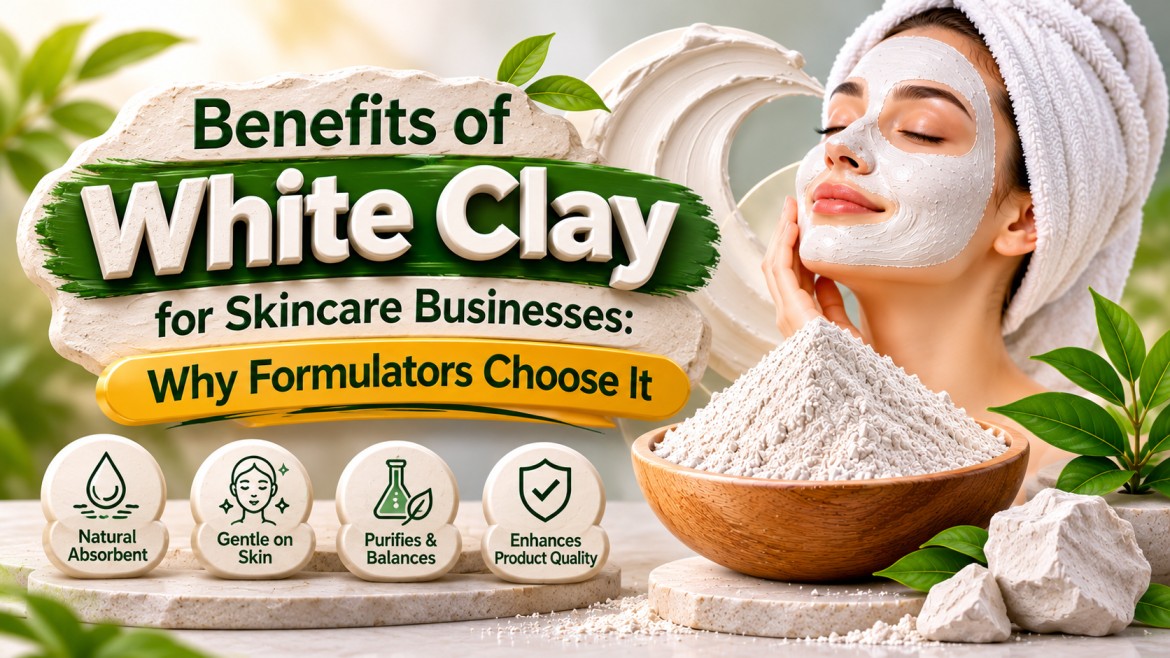
Walk through any skincare lab, soap workshop or private label unit, and white clay is rarely far away. It sits in face masks, cleansing powders, soaps and dry products, quietly doing several jobs at once. For brands, spas and manufacturers, the benefits of white clay go well beyond what the consumer sees on the label: it is gentle, easy to work with, visually clean and widely accepted. This guide explains why formulators choose it, what to check before buying, and how to source it reliably in bulk.
What Is White Clay?
"White clay" is the common name for kaolin, also sold as China clay. It is a naturally occurring clay made mainly of the mineral kaolinite, valued for its fine particle size, pale color and mild behavior on skin. It differs from clays such as bentonite or Fuller's earth (multani mitti), which are typically montmorillonite-based and tend to absorb more oil and feel stronger on skin.
At Zillion Sawa Minerals Pvt. Ltd. we supply kaolin to cosmetic and pharmaceutical customers, and our Kaolin Clay and China Clay ranges are built around the quality checks those industries ask for: color, purity and consistency.
Key Benefits of White Clay for Skincare Businesses
1. Gentle on Skin
White clay is among the mildest cosmetic clays. That makes it suitable for products aimed at sensitive, normal and combination skin, and it gives brands a safer starting point when developing masks and cleansers. As with any ingredient, a final product should always be tested for its target users.
2. Helps Absorb Excess Oil
White clay can absorb surface oil without being as aggressive as stronger clays. Formulators often use it in products for oily and combination skin where the goal is a balanced, matte feel, not a stripped one.
3. Clean, Neutral Color
Its pale color gives formulators flexibility. It does not heavily tint a formula, so natural colorants can be added to create soft pink, yellow or earth tones. For brands that want natural tints, our Red Ochre and Yellow Ochre are commonly paired with white bases. You can read more in our guide to yellow ochre powder.
4. Smooth Texture and Slip
Fine kaolin gives masks, powders and soaps a soft, silky feel. This improves the user experience, which matters for repeat purchases.
5. Easy to Formulate With
Compared with strongly swelling clays, kaolin is generally easier to handle in many formulations, since it behaves predictably in water-based masks and dry blends. Formulators still need to run their own stability and compatibility tests.
6. Mild Cleansing and Gentle Exfoliation
White clay can help lift surface impurities and loosen dead skin cells during rinsing, giving skin a smoother feel. Claims should stay within what regulations allow for cosmetics.
7. Versatile Across Product Types
White clay appears in face masks, cleansing powders, soaps, body scrubs, talc-free powders and hair and scalp masks. This versatility lets a brand use one raw material across several products, simplifying sourcing.
8. Familiar and Consumer-Friendly
Consumers recognize white clay and kaolin as natural, gentle ingredients, which supports clean-label positioning when the final product backs it up.
White Clay vs Bentonite vs Multani Mitti: Quick Comparison for Formulators
|
Feature |
White Clay (Kaolin) |
Bentonite |
Multani Mitti (Fuller's Earth) |
|
Main mineral |
Kaolinite |
Montmorillonite |
Typically montmorillonite (varies) |
|
Strength on skin |
Gentle |
Strong |
Stronger |
|
Oil absorption |
Mild to moderate |
High |
High |
|
Color |
White to off-white |
Cream to grey |
Cream to buff |
|
Best for |
Sensitive, normal, combination |
Oily, deep-cleansing |
Oil control |
Treat this as a guide only, since properties vary by source and processing.
What Formulators Should Check Before Buying White Clay
Quality decides whether white clay performs. Before placing a bulk order, ask suppliers about:
-
Cosmetic-grade suitability: Is the material intended for cosmetic use?
-
Color and brightness consistency between batches
-
Particle size and fineness for your product type
-
Purity and absence of contaminants, including grit
-
Safety documentation: Ask for a certificate of analysis and what testing is done, including heavy metals and microbial limits where relevant to your market
-
Sample availability for your own lab trials
-
Packaging and storage conditions
-
Supply consistency for repeat orders
Be cautious of suppliers who cannot explain their testing, or who avoid sharing documentation.
How Zillion Sawa Minerals Supports Cosmetic Buyers
We follow a simple, transparent process built for B2B buyers:
-
Product Support: We help you identify the right specification.
-
Free Samples: Samples are provided for laboratory testing.
-
Plant Trial Quantity: Once a sample is approved, you can order a trial quantity.
-
Consistent Supply: After a successful trial, you can scale your orders.
We source minerals from across Rajasthan and supply industries including cosmetics, pharma, ceramics, paints, paper and rubber. Some brands also use Talc/Soapstone in powder products, and we supply Calcium Carbonate Powder for other filler needs.
For technical background, our Mineral Guide offers detailed explanations, our Certification page shows our credentials, and you can learn more about our company or read more on our blog.
Final Thoughts
The benefits of white clay explain why it remains a staple for skincare businesses: it is gentle, versatile, visually clean and easy to work with. But those benefits only show up when the clay is consistent and well documented. Test samples in your own lab, ask for clear specifications and choose a supplier who can support repeat orders.
Looking for white clay for your skincare range? Get in touch with Zillion Sawa Minerals Pvt. Ltd. for samples, specifications and bulk supply options.
Frequently Asked Questions
Is white clay the same as kaolin clay?
Yes. White clay is the common name for kaolin, also called China clay.
What are the main benefits of white clay in skincare products?
It is gentle, helps absorb excess oil, has a neutral color, feels smooth and works across masks, powders and soaps.
Is white clay suitable for sensitive skin products?
It is generally the mildest cosmetic clay, but every final product should be tested for its intended users.
What is the difference between white clay and bentonite?
White clay is kaolinite-based and gentle, while bentonite is montmorillonite-based and absorbs more oil with a stronger action.
What should I ask a supplier before buying white clay in bulk?
Ask about cosmetic suitability, particle size, color consistency, purity, test documentation and sample availability.
Can I get samples before ordering?
Yes. Contact our team to request samples for laboratory testing.